
Stamping Out Dissent
Democracy, History, The Left, The Right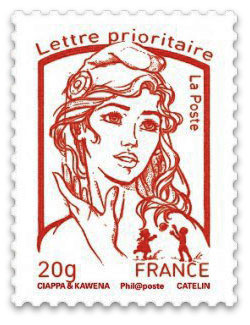 My fixation on female national personifications continues:
- Last week I blogged about Lady Liberty.
- Today, the Freeman features my article on the Goddess of Democracy statue from China’s 1989 Tiananmen Square protests.
- Now I learn that France’s Marianne is in the news.
Socialist president François Hollande has successfully courted controversy in his Bastille Day announcement of a new national postage stamp.
Since 1944, each new French president has chosen a new illustration for France’s postage stamps — always an image of Marianne, the Phrygian-hat-wearing feminine symbol of the French Republic (the way the UK has Britannia and the US used to have Columbia before Uncle Sam elbowed her aside).
"I decided following my election," said Hollande, "that the Republic’s new stamp would have the face of youth, that it would be created by youth, and that it would be chosen by youth."
Chosen by youth? Check. The design was chosen from a list of 15 finalists "preselected by a jury that included schoolchildren." (The French, by the way, are very candid about the importance of the French school system for indoctrinating children. They are much more comfortable with the idea than most Americans seem to be. French schools must instill "republican values." This is what always comes up in discussions of homeschooling and laws against Muslim girls wearing veils.)
Created by youth? Maybe. The stamp was designed by 34-year-old French artist and gay-rights activist Oliver Ciappa, who says the new stamp "blends elements of Renaissance art, French comics, Japanese manga, and US animation from the 1950s."
Face of youth? Previous models for Marianne have included Brigitte Bardot and Catherine Deneuve. Hollande and Ciappa decided to go a different direction. And this is what is causing the controversy. The new Marianne is inspired by 23-year-old Inna Shevchenko, a leader in the Ukrainian feminist protest group called FEMEN.
Shevchenko has just been granted political asylum in France.
According to the Atlantic,
The flamboyant activist ran afoul of Ukrainian authorities after cutting down a cross with a chainsaw in central Kyiv, wearing only skimpy shorts, in support of jailed members of the Russian punk feminist collective Pussy Riot.
"It’s great to enter history in this manner," said Shevchenko. "But the nicest part of it is that now every time a homophobe, a fascist, or an extremist in France wants to send a letter by mail, he will have to lick Femen’s [backside]." (The BBC reports that she used a much ruder word than "backside." My francophone wife guesses that Shevchenko really said cul.)
The US Postal Service has had its share of stamp controversies. Thin Elvis versus fat Elvis comes to mind. But it seems like the French president is deliberately seeking to provoke a large segment of the French population — the ones who didn’t vote for him.
Thomas Jefferson, a supporter of the French Revolution and a fan of the French Republic at a time when American republicans were divided on the question of France, famously wrote,
To compel a man to furnish contributions of money for the propagation of opinions which he disbelieves and abhors, is sinful and tyrannical.
I guess we should not be surprised that a Socialist president would beg to differ. So would almost all American politicians.
Stamping Out Dissent Read Post »

 …
…